

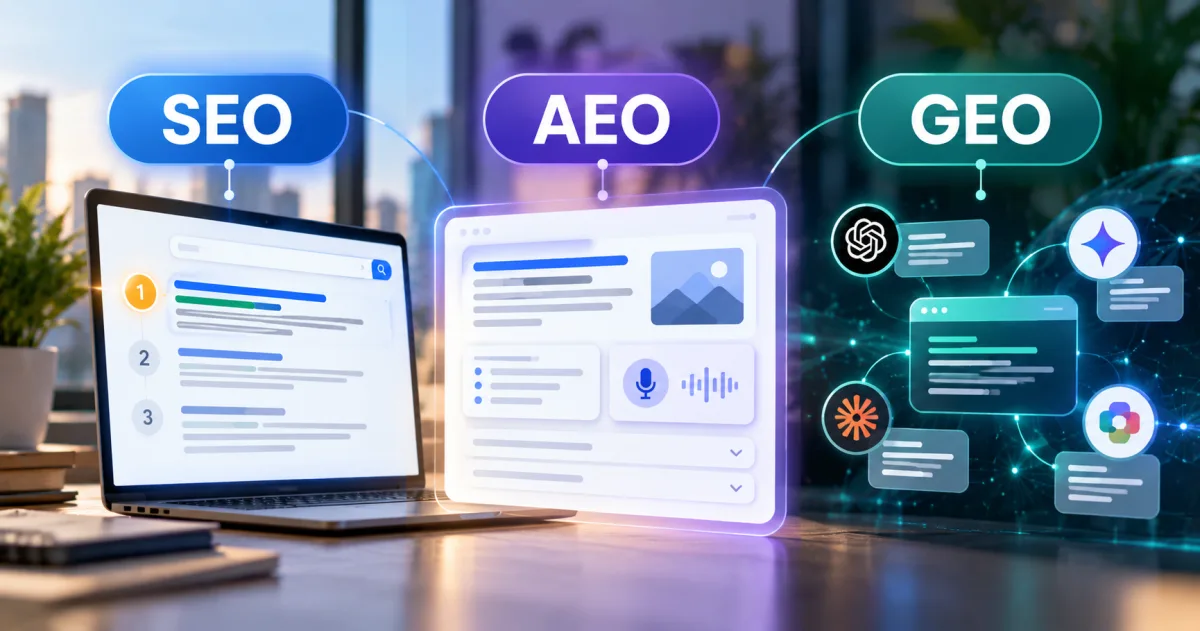
What's the difference between SEO, AEO and GEO?
SEO (search engine optimization) gets your pages ranked in search results. AEO (answer engine optimization) structures your content so it becomes the direct answer in featured snippets, voice search and AI Overviews. GEO (generative engine optimization) makes your brand a source that AI tools like ChatGPT and Perplexity cite. You need all three, and they share one foundation.
What is SEO?
SEO is the practice of improving your website so it ranks higher in search engines like Google and Bing for the searches your buyers make. It covers three areas: technical health (can search engines crawl and index your pages quickly), relevance (does your content match what people are searching for) and authority (do other trusted sites link to and mention you).
The goal of SEO is a click. You win when your page appears near the top of the results and the searcher chooses you over the other options.
What is AEO?
AEO, or answer engine optimization, is the practice of structuring content so search engines and AI assistants can lift it as the direct answer to a question. It targets featured snippets, People Also Ask boxes, voice assistants and Google's AI Overviews.
Answer engines favor content that is easy to extract. That means:
- Headings phrased as the questions people actually ask.
- A direct answer of about 40 to 60 words right below each heading.
- Lists and tables for steps, comparisons and specifications.
- Structured data like FAQ, HowTo, Article and Organization schema.
- Clear definitions written in plain language.
The goal of AEO is to be the answer, even when the user never clicks.
What is GEO?
GEO, or generative engine optimization, is the practice of making your brand a trusted source that generative AI tools cite and recommend. It targets ChatGPT, Perplexity, Gemini, Claude, Copilot and AI Overviews when they generate answers.
Large language models build answers from search results they retrieve and from patterns across the web. Brands that show up in those answers tend to have:
- Consistent entity information: the same name, description and facts on their website, LinkedIn, directories and profiles.
- Original data and first-hand expertise that can't be found anywhere else.
- Mentions on reputable third-party sites, not only on their own website.
- Content that already ranks in traditional search for the underlying queries.
The goal of GEO is to be named. When someone asks an AI tool for a recommendation in your category, your brand is part of the answer.
SEO vs AEO vs GEO at a glance
| SEO | AEO | GEO | |
|---|---|---|---|
| Goal | Rank in search results | Be the direct answer | Be cited or recommended by AI |
| Where you show up | Google and Bing results | Featured snippets, voice, AI Overviews | ChatGPT, Perplexity, Gemini, Copilot |
| Main signals | Technical health, relevance, links | Answer-first structure, schema | Entity clarity, mentions, original data |
| Win condition | A click | An extracted answer | A brand mention or citation |
| How to measure | Rankings, clicks, organic leads | Snippet and AI Overview visibility | AI citations and AI referral traffic |
How do SEO, AEO and GEO work together?
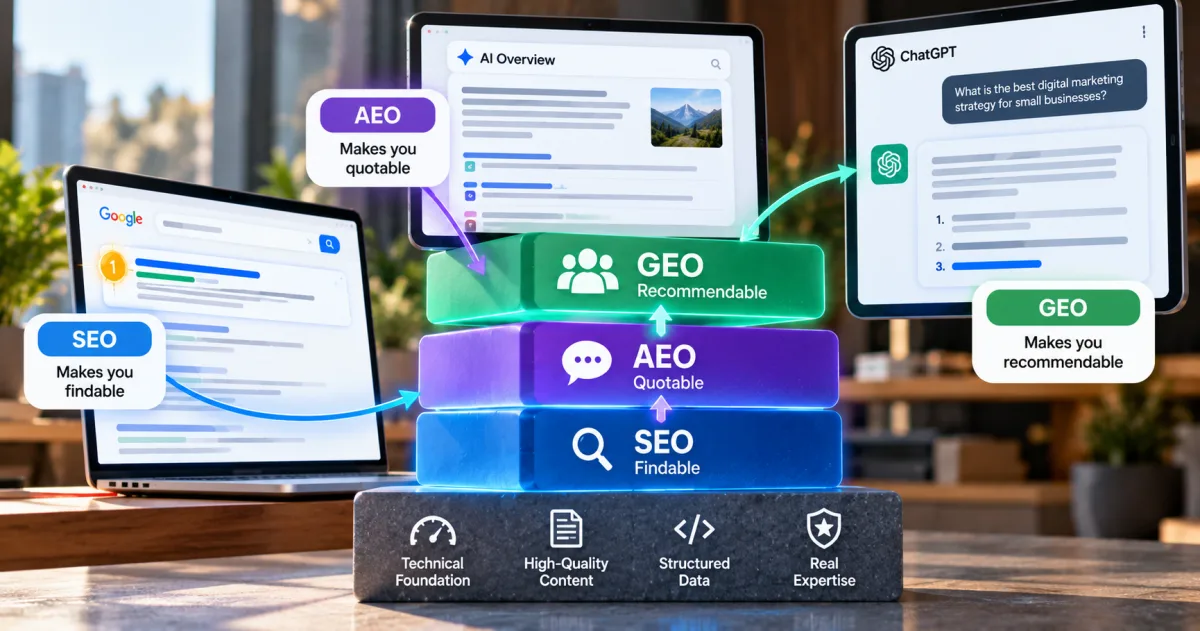
Think of them as three layers on one foundation. SEO makes you findable, AEO makes you quotable and GEO makes you recommendable. A page that loads fast, targets a real question, answers it in the first paragraph, uses schema and is backed by original expertise does all three jobs at once.
That's why I don't treat them as separate services. The same page, written and structured well, can rank in position one, appear in the AI Overview above it and get cited when someone asks ChatGPT the same question.
Which one should you focus on first?
Start with SEO fundamentals, then layer AEO and GEO on top. If search engines can't crawl your site or your pages don't match search intent, no amount of formatting will get you cited. A practical order:
- Fix technical SEO issues: indexing, speed, mobile usability and redirects.
- Rewrite your most important pages answer-first, with question headings and schema.
- Make your entity data consistent across your website, LinkedIn and directories.
- Publish original insights from your own work: data, frameworks and case studies.
- Earn mentions on trusted industry sites, podcasts and publications.
How do you measure AEO and GEO results?
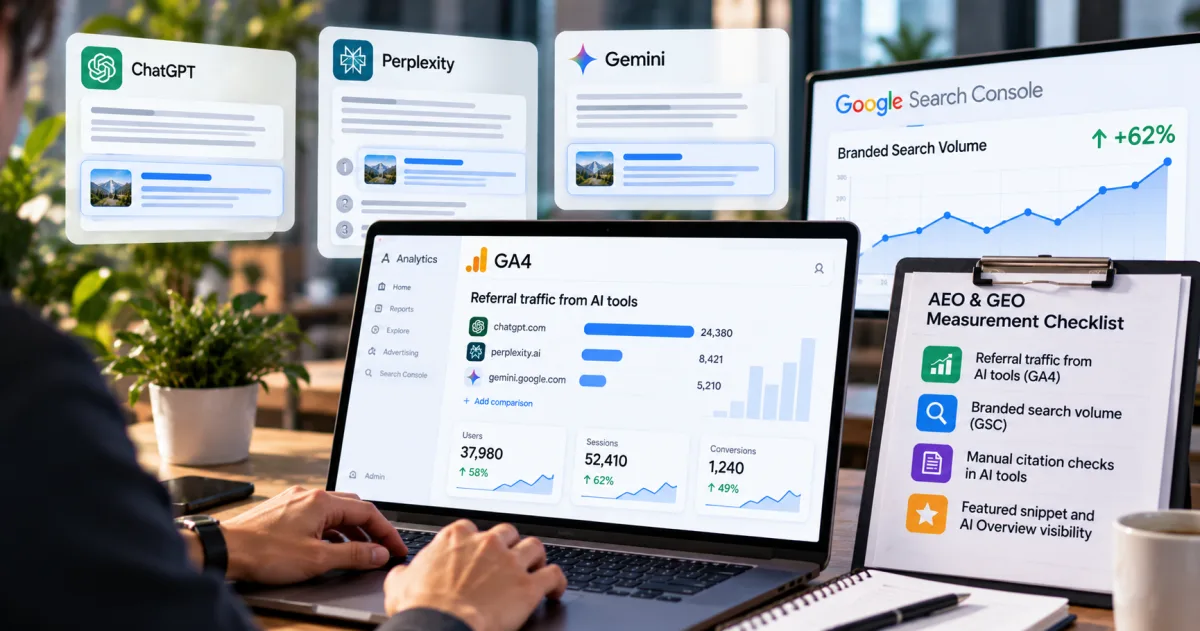
Traditional rankings don't capture everything anymore. Track these alongside your usual SEO metrics:
- Referral traffic from AI tools such as chatgpt.com, perplexity.ai and gemini.google.com in GA4.
- Branded search volume in Google Search Console, which tends to rise as AI tools mention you.
- Manual citation checks: ask AI tools the questions your buyers ask and record whether you're named.
- Featured snippet and AI Overview visibility for your priority keywords.
Frequently asked questions
Is GEO replacing SEO?
No. Most AI answer engines retrieve information from search indexes, so pages that rank well are more likely to be cited. GEO adds entity and reputation work on top of SEO; it doesn't replace it.
Does llms.txt help with GEO?
llms.txt is a proposed file that summarizes your site for AI tools. Major AI companies haven't confirmed they use it, but it's cheap to maintain and does no harm, so I include it as a low-cost extra rather than a core tactic.
Is AEO the same as optimizing for featured snippets?
Featured snippets are one part of AEO. AEO also covers People Also Ask, voice assistants and AI Overviews, which all reward the same answer-first structure.
How long does it take to show up in AI answers?
It depends on your existing authority. Sites that already rank well can start appearing in AI answers within weeks of restructuring content. Newer sites need to build rankings and mentions first, which usually takes several months.
Confirm by email. Unsubscribe anytime. Privacy policy

T-shaped marketer and fractional CMO with 20+ years across QA engineering, project management and marketing leadership. Specializes in SEO, AEO, GEO, paid media and web.
More articles by Melencio →Connect on LinkedIn →