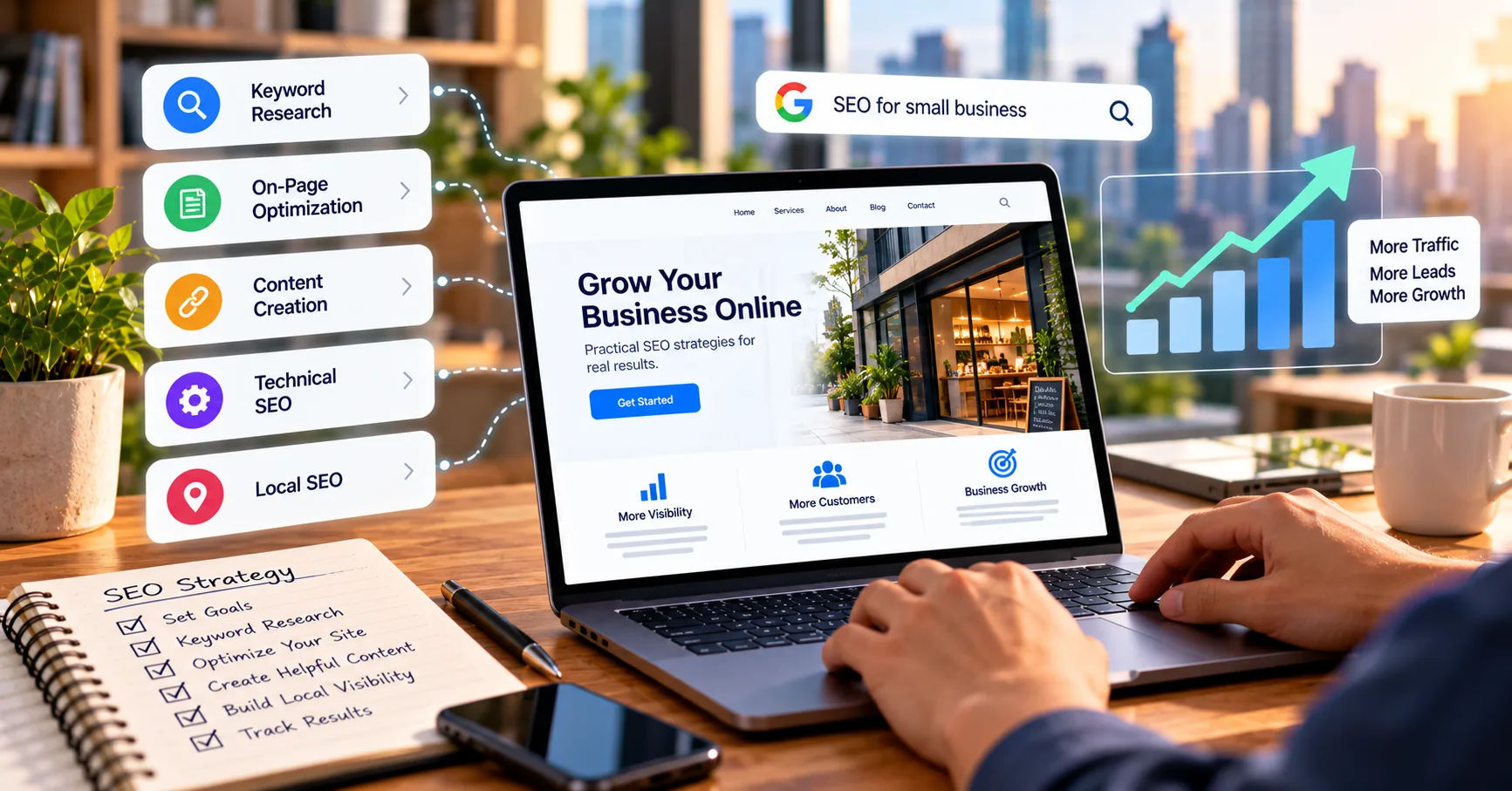

How Does an SEO Strategy for Small Business Work?
An SEO strategy for small business means choosing local search terms, fixing your site structure, and publishing helpful answers for nearby customers. I build it in that order so a lean team or solo owner can show up on Google and bring in steady traffic without paying for ads.
This guide covers the exact steps I use to plan, build, and run an organic search campaign for lean teams and solo owners. You will learn how to pick search terms, track your progress, and fix technical errors without needing a massive marketing budget.
This guide covers the exact steps I use to plan, build, and run an organic search campaign for lean teams and solo owners. You will learn how to pick search terms, track your progress, and fix technical errors without needing a massive marketing budget.
What You Need Before You Start SEO
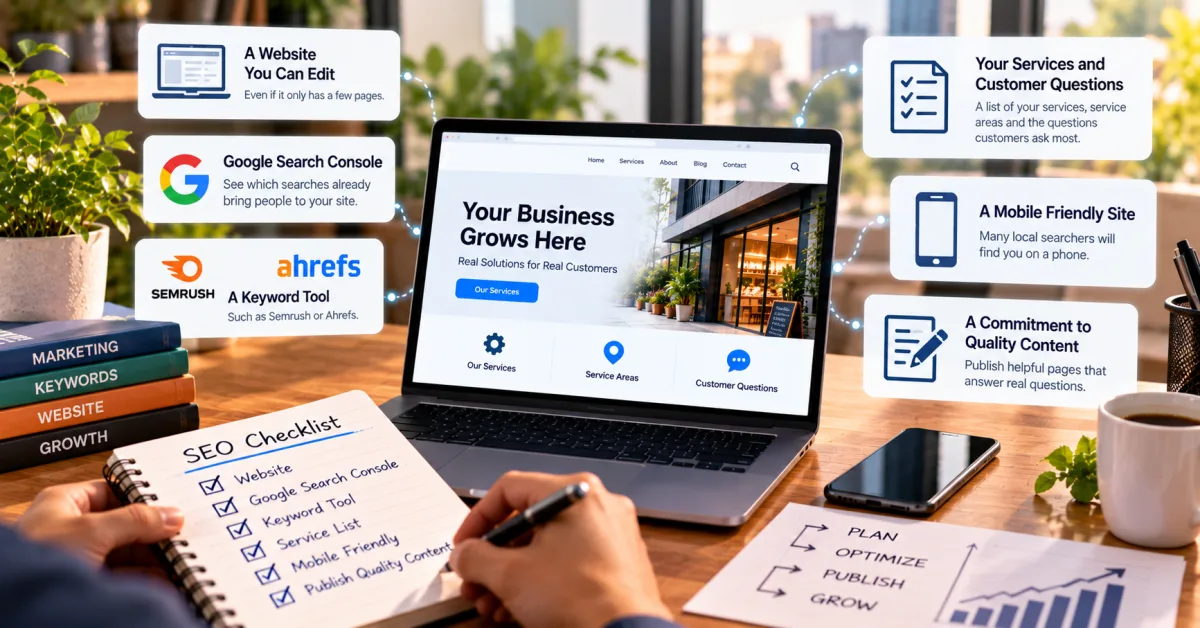
You need a working website, access to Google Search Console, a list of your services, and a few hours of focused time. Nothing here requires a big budget. Most of it is knowledge you already have about your business.
This is the checklist I run through before I touch a single keyword:
- A website you can edit, even if it only has five pages.
- Google Search Console set up, so you can see which searches already bring people to your site.
- A keyword tool such as Semrush or Ahrefs for researching search terms.
- A plain list of your services, your service areas, and the questions customers ask you most.
- A mobile friendly site, because many local searchers will find you on a phone.
- A commitment to publish high quality pages that answer real questions instead of padding.
I also like to take stock of what you already have online. A content audit is a review of your existing pages to decide what to keep, update, or remove, and Semrush walks through the process in detail. Learn more about content audits here.
A rough spreadsheet with your page URLs and titles is enough to start. You can polish it as you go.
What is small business SEO?
Small business SEO is the work of shaping your website and online presence so Google and other search engines show you to people searching for what you sell. It follows the same basic rules as any SEO, but it fits a smaller budget, a tighter service area, and fewer pages.
For most small businesses, local SEO sits at the center. It means appearing when someone nearby searches for your service, often on a map or in a short list of results. Your seo strategy should start there before you chase broader topics.
Quick SEO Wins for Small Businesses
A few moves carry most of the weight:
- Claim and fill out your Google business listing with accurate details.
- Ask happy customers for reviews on Google and Yelp.
- Give each core service its own page with plain, useful content.
- Add short FAQs that answer what customers actually ask you.
How should small businesses get started with SEO?
Start small and work in order:
- Search for your main service the way a customer would.
- Write down which competitors appear and what their pages offer.
- Pick one of your service pages and improve it first.
Search is also shifting toward AI answers. My guide on seo vs aeo vs geo explains how those pieces differ and where each one fits.
What is SEO and how does it work?
SEO, or search engine optimization, is the practice of shaping your website so search engines can find it, understand it, and show it to people searching. Google and Bing handle this through what Moz calls their three primary functions: crawling, indexing, and ranking. Bots visit your pages, store what they find, and then order results by how well each page matches a search.
SEO focuses on three areas: the content on your pages, the technical health of your site, and the trust signals pointing to your business. Customer reviews are one of those signals, and Search Engine Journal reports that they've been proven to play a leading part in how local businesses rank. Each area gives search engines more reason to show you.
So how do you improve your SEO? Start with small, ordered actions:
- Open Google Search Console and check which of your pages are indexed.
- Assign each page one clear topic and one type of searcher.
- Rewrite thin pages so they answer the question a customer would actually type.
- Fix broken links and slow pages that make visitors leave.
- Add links from your home page to your most important pages.
That last step is easy to skip, yet it costs nothing. Internal links show search engines which pages matter most on your site, and they help visitors reach those pages in one click. I check them every time I review a small business website.
How to Build an SEO Strategy for Small Business
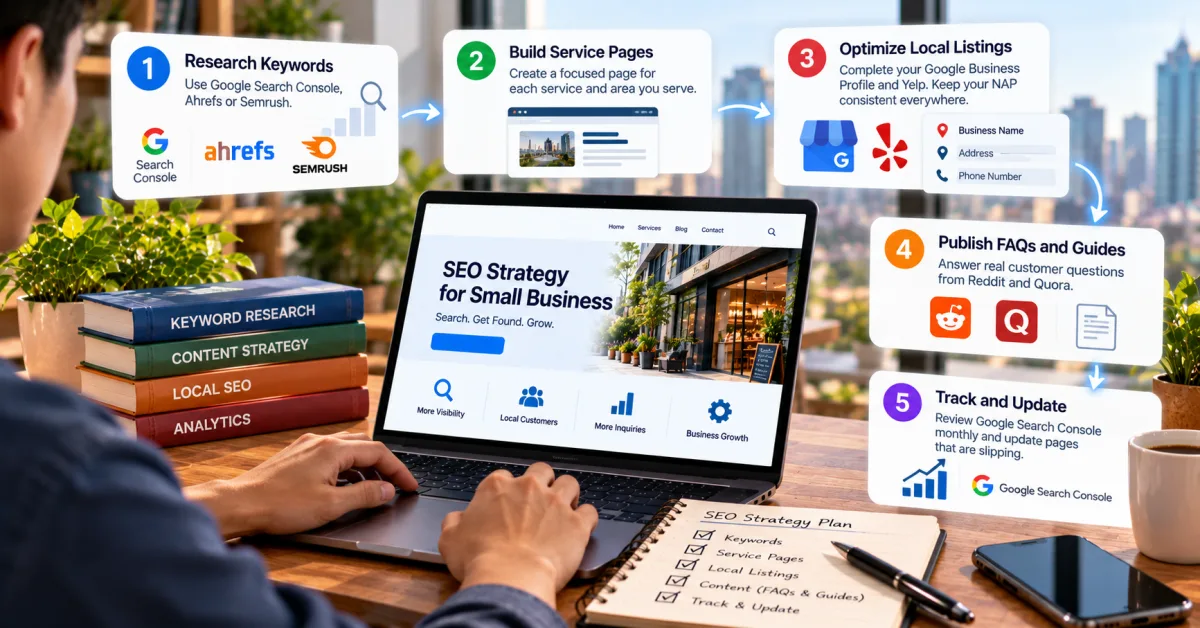
Effective SEO strategies for small businesses focus on local searches, clear service pages, helpful answers, and steady tracking instead of chasing huge, competitive keywords.
These are the top five SEO strategies I use, in the order I'd do them:
- Research the phrases your customers actually type, using Google Search Console, Ahrefs, or Semrush.
- Build one focused page for each service and each area you serve.
- Complete your Google listing and your Yelp profile, and keep your name, address, and phone number identical everywhere.
- Publish FAQs and short guides that answer real customer questions in plain language.
- Review Google Search Console every month, then update pages that are slipping.
Step four deserves extra attention. Browse Reddit and Quora threads in your industry to see how people word their problems, then answer those questions on your own site. Clear, direct answers are also easier for AI tools to quote, which is the idea behind GEO.
You don't need to do all five at once. Start with one service page and one listing, then build from there.
I share more walkthroughs like this on my marketing blog, so check back as you work through each step.
What Should a Small Business SEO Strategy Include?
A complete small business SEO strategy should cover more than keywords and blog posts. The table below shows the main areas I would work through, what each one involves, and why it matters.
| SEO Strategy Area | What You Should Do | Why It Matters |
|---|---|---|
| SEO goals | Decide whether you want leads, calls, sales, bookings, or traffic | Gives your SEO work a measurable business goal |
| Keyword research | Find terms your customers actually search for | Helps you target realistic search demand |
| Search intent | Determine whether people want information, a service, product, or comparison | Helps you create the right type of page |
| Keyword mapping | Assign one primary topic to each important page | Reduces keyword cannibalization |
| Service pages | Build a useful page for every important service | Targets searches with stronger buying intent |
| Technical SEO | Check indexing, speed, mobile usability, broken links, and crawlability | Helps search engines access and understand the site |
| Local SEO | Optimize your Google Business Profile and local business information | Helps local businesses appear in nearby searches |
| Content | Publish answers to questions potential customers ask | Builds topical authority and captures informational searches |
| Internal linking | Connect related articles and important service pages | Helps users and search engines understand site structure |
| Authority | Earn reviews, relevant links, citations, and brand mentions | Builds trust and credibility |
| AEO/GEO | Structure direct answers and authoritative content for AI search | Improves visibility beyond traditional search results |
| Measurement | Track impressions, clicks, conversions, and leads | Shows whether the strategy is producing business results |
What is the 80/20 rule in SEO?
The 80/20 rule in SEO says a small share of your work, about 20%, produces most of your results, about 80%. It's a rule of thumb, not a measured number.
The idea comes from the Pareto principle. For a small business, it means a handful of pages, search terms, and fixes drive most of your traffic and leads. The rest of your site mostly sits quietly in the background.
Good SEO starts with finding that small group and spending your hours there. I usually check these areas first:
- Service pages that bring in calls or form fills
- Pages that already rank on the second page of Google and need a small push
- Page speed problems on your most visited pages
- Local details, like your address and service area wording
Here is how to put the rule to work:
- Decide which result matters most to your business, such as booked jobs, phone calls, or quote requests.
- Mark the few pages that bring in most of your visits and most of that result.
- Improve those pages first by sharpening the titles, adding missing answers, and fixing slow loading.
- Hold off on new blog posts until those pages are solid.
Most small business owners feel pulled in ten directions at once. This rule gives you permission to ignore most of the noise. If you want help choosing the right 20%, my marketing services can point you there.
Optimize Your Google Business Profile
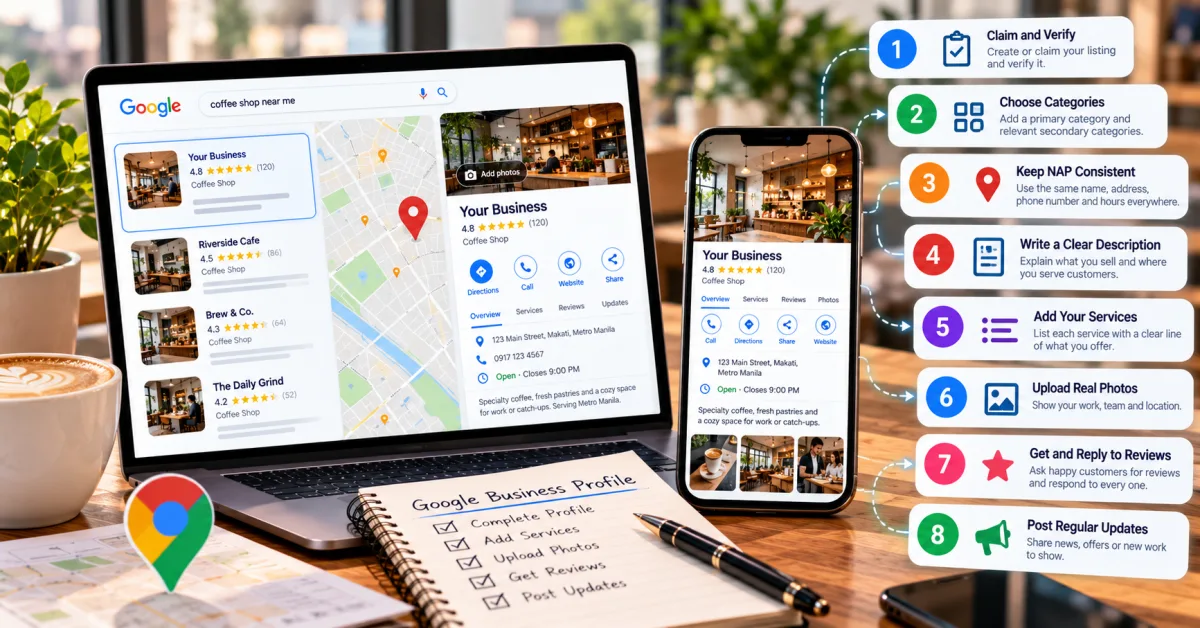
Your Google Business Profile is the free listing that shows up on Google Maps and in local search results. For many small businesses, it's the first thing a customer sees, so I start here before touching the website.
Search Engine Land makes the point in a blog post that useful, relevant content is what helps pages rank. I apply the same thinking to a profile: complete, accurate, and written for real customers.
Here is how I set one up:
- Claim or create your Google Business listing, then verify it so you control the details.
- Choose a primary category that matches your main service, and add secondary categories only if they are true.
- Enter your name, address, phone number, and hours exactly as they appear on your website.
- Write a short description in plain language that covers what you sell and where you serve customers.
- Add your services, with a clear line about each one.
- Upload real photos of your work, your team, and your location.
- Ask happy customers for reviews, and reply to every one, including the critical ones.
- Post updates when you have news, offers, or new work to show.
Check your details on Yelp and other directories too. Mismatched phone numbers or addresses confuse customers and search engines alike.
Common mistakes to avoid
Most small business SEO problems come from a few habits that are easy to fix once you spot them. Here are the ones I see most often.
- Targeting huge keywords first. Broad terms are crowded with big brands. Start with specific, local phrases that potential customers actually type when they need you.
- Stuffing keywords into every sentence. Repeating a phrase over and over makes your copy hard to read. Write for a person, then check that the main term appears where it fits.
- Skipping Google Search Console. Without it, you are guessing which pages get seen and which have errors. Open it at least once a month.
- Publishing thin pages. A service page with two lines tells Google and visitors very little. Explain what you do, who it helps, and how to contact you.
- Copying competitors. Borrowed text rarely matches your real services. Your own details, such as your area, your process, and your answers to customer FAQs, set you apart.
- Ignoring Bing. Some of your customers search there, so submit your site and check it occasionally.
- Expecting overnight results. SEO builds over time. Judge progress by steady gains in impressions and clicks, not by a single week.
- Leaving old information online. Wrong hours, outdated prices, or a dead phone number cost you trust and calls.
Next steps: Book a free consultation
A solid SEO plan for a small business comes down to a few steady habits: show up where local customers look, say clearly what you do, and check your numbers so you know what's working. Pick one step this week and finish it before you move to the next. A single completed task, like a verified business listing, will teach you more than five half-finished ones.
If you'd like a second set of eyes, I'm happy to look at your situation with you. Book a free consultation and I'll talk through where you are now and what makes sense to tackle first. There's no pressure and no obligation, just a friendly conversation about your website.
Written by Melencio Sapnu III. Reviewed by Vanessa Atan.
Frequently asked questions
Is SEO still worth it in 2026?
Yes, SEO is still worth it in 2026 for most small businesses, because people still turn to Google and Bing when they need a local provider. Unlike ads, a page that ranks keeps working after you stop paying for clicks. It also builds over time, so every service page and helpful answer you publish adds to what you already have.
What are the top 5 SEO strategies?
The top five are claiming your local listing, researching realistic search terms, building one clear page per service, publishing helpful answers to customer questions, and tracking results in Google Search Console. If you only have time for one extra habit, check Search Console monthly to see which queries already bring impressions, then improve those pages first.
Confirm by email. Unsubscribe anytime. Privacy policy

T-shaped marketer and fractional CMO with 20+ years across QA engineering, project management and marketing leadership. Specializes in SEO, AEO, GEO, paid media and web.
More articles by Melencio →Connect on LinkedIn →